China-Originated Innovation
Shanghai's First Deal Room: What We Saw at CPIC 2026
Kerlann spent CPIC 2026 in Shanghai's exhibition halls and BD sessions. Here's what the conference's first edition tells us about where China pharma dealmaking is headed.
On the ground at CPIC 2026
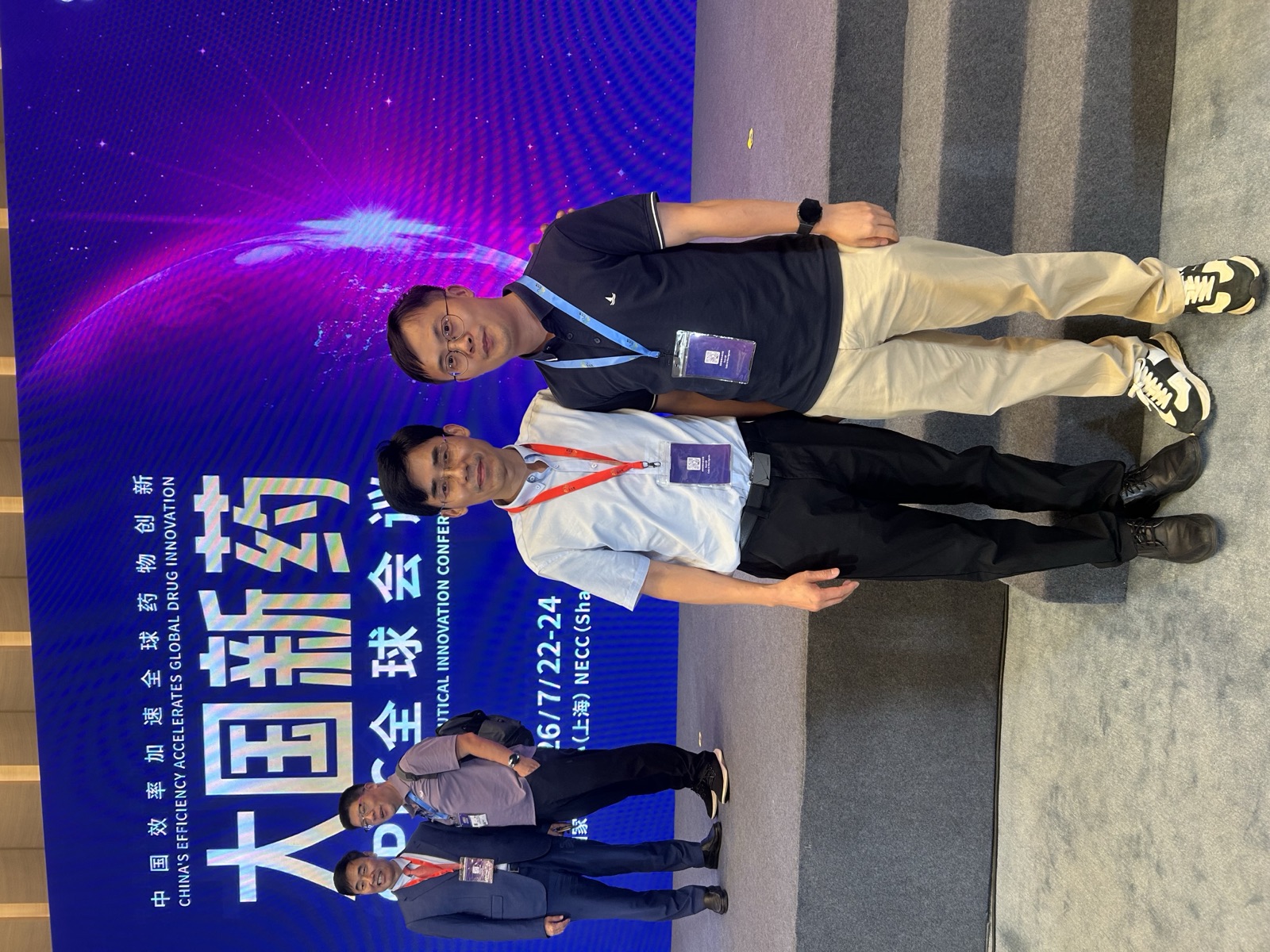
Kerlann spent July 22–24 at the National Exhibition and Convention Center in Shanghai, moving between BD workshops, exhibition halls, and capital-markets panels at CPIC 2026, the first edition of the China Pharmaceutical Innovation Conference. We came away with a straightforward read: this was a genuinely good conference. The prospective conversations were excellent, the room was full of the right people, and the ambition behind the event is bigger than its first-year size suggests.
That ambition is not subtle. CPIC's own English-language materials describe the conference as "modelled after the J.P. Morgan Healthcare Conference." That's the invitation-only January gathering in San Francisco that has anchored global biopharma's dealmaking calendar for more than four decades. CPIC's founder, Dr. Cheng Zengjiang, has been direct about the motivation: major global pharma summits are all held overseas, and Chinese industry professionals have had to travel abroad every year to find partners. CPIC exists to give China's pharmaceutical industry its own main stage.
A First Edition, Sized Like a Fourth Decade
Some comparison is useful here. JP Morgan's healthcare conference started in 1983 with roughly 200 attendees and about 20 presenting companies, hosted by the boutique investment bank Hambrecht & Quist. It took the better part of four decades to grow into today's event. Around 8,000 people are now officially badged attendees, with an estimated 20,000 citywide once the surrounding "JPM Week" of satellite meetings is counted.
CPIC's first edition, by the organizer's own count, drew more than 20,000 attendees from 22 countries; independent wire coverage of the opening day put the figure above 10,000. Either number is a striking debut for a conference that didn't exist a year ago. Add to that more than 300 exhibitors, close to 900 speakers, and roughly 65 sessions running across parallel tracks in Shanghai's Golden Hall and half a dozen themed halls. On a fair basis, the comparison should measure CPIC's year one against JPM's year one, not against JPM as it exists after four decades. On that basis, CPIC launched roughly at the scale it took JPM decades to reach.
We don't think that scale comparison should be overread. CPIC is not yet the dealmaking center of gravity that JPM is for global pharma. But the intent is explicit, the organizing muscle (20-plus co-organizing partners, from Fudan University to WuXi AppTec to major Chinese and international law and accounting firms) is real, and the first-year execution was, in our experience on the ground, genuinely solid. If CPIC keeps this trajectory, "modest first year, fast-growing after" looks like the right way to bet on it. That trajectory is helped enormously by the underlying strength of the Chinese biotech ecosystem it's built on top of.
The Session That Made the Numbers Concrete
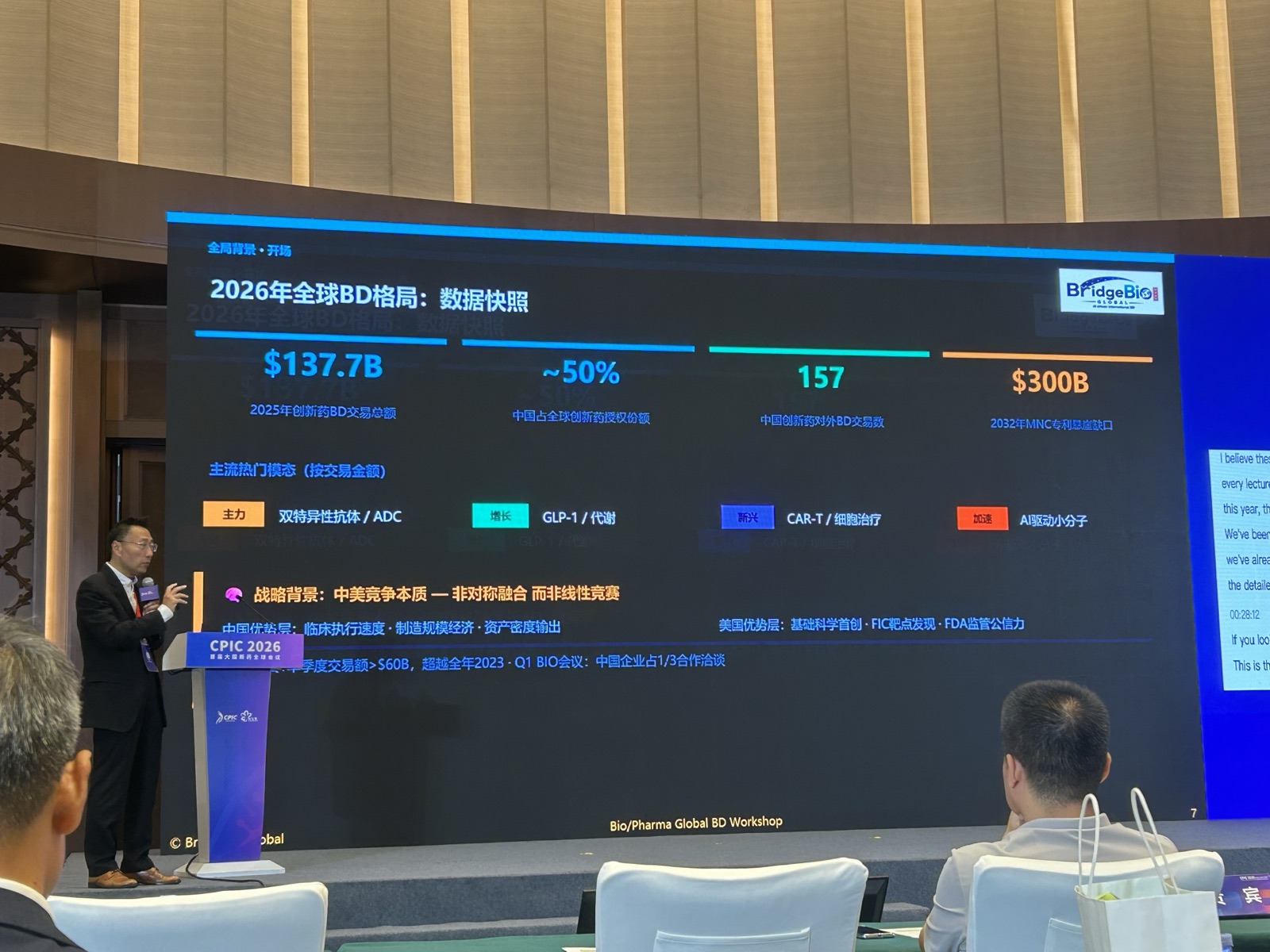
The most useful single hour we spent at CPIC was a BD workshop led by Tony Zhang, CEO and co-founder of BridgeBio Global, unpacking the current state of global biopharma dealmaking. His opening slide put a number on what everyone in the room already sensed: $137.7 billion in total 2025 innovative-drug BD deal value, with China's share of global licensing activity now approaching half, across 157 outbound deals from Chinese companies. That figure lines up closely with what multiple independent Chinese trade-data trackers have reported for the same year, so it isn't resting on one source.
The framing that stuck with us most was Zhang's description of the underlying dynamic as "asymmetric integration, not a linear race." China's advantages, in his telling, sit in clinical execution speed, manufacturing scale economics, and sheer output density; the US retains the edge in first-in-class target discovery, foundational science, and regulatory credibility. Deal structures are evolving accordingly: fewer single-asset license-outs, more platform deals, NewCo structures, and co-development arrangements that let both sides keep contributing after signing rather than handing off a finished asset. We'll go deeper on the specific deal data, named transactions, and the regulatory friction points (BIOSECURE, the proposed BINSA legislation, China's human genetic resources export rules) in the next article in this series.
Domestic Deals Are Becoming Their Own Story
One thread we want to flag early, because it's underappreciated outside China: several CPIC sessions were about Chinese pharmaceutical companies doing deals with each other, a quieter pattern running alongside the licensing deals with Western partners that get all the trade-press attention. Sino Biopharmaceutical's roughly $950 million acquisition of LaNova Medicines. Hengrui Pharma's domestic license of an early-stage asset to Hansoh Pharma. Luye Pharma's licensing of long-acting antipsychotics to Enhua Pharmaceutical. All three: Chinese buyers, Chinese sellers, Chinese-market rights, no Western counterparty involved.
This intra-China dealmaking gets a fraction of the trade-press attention that outbound licensing receives, but the signal is the same one CPIC itself represents: China's pharmaceutical industry has enough scale and enough differentiated assets now that dealmaking activity is turning inward as well as outward. A domestic BD ecosystem that trades assets among Chinese companies, running in parallel with the outbound wave everyone already talks about, is a fuller picture than "China licenses out to the West" on its own. We'll dedicate a full article in this series to that trend specifically.
The World Is Also Coming to China
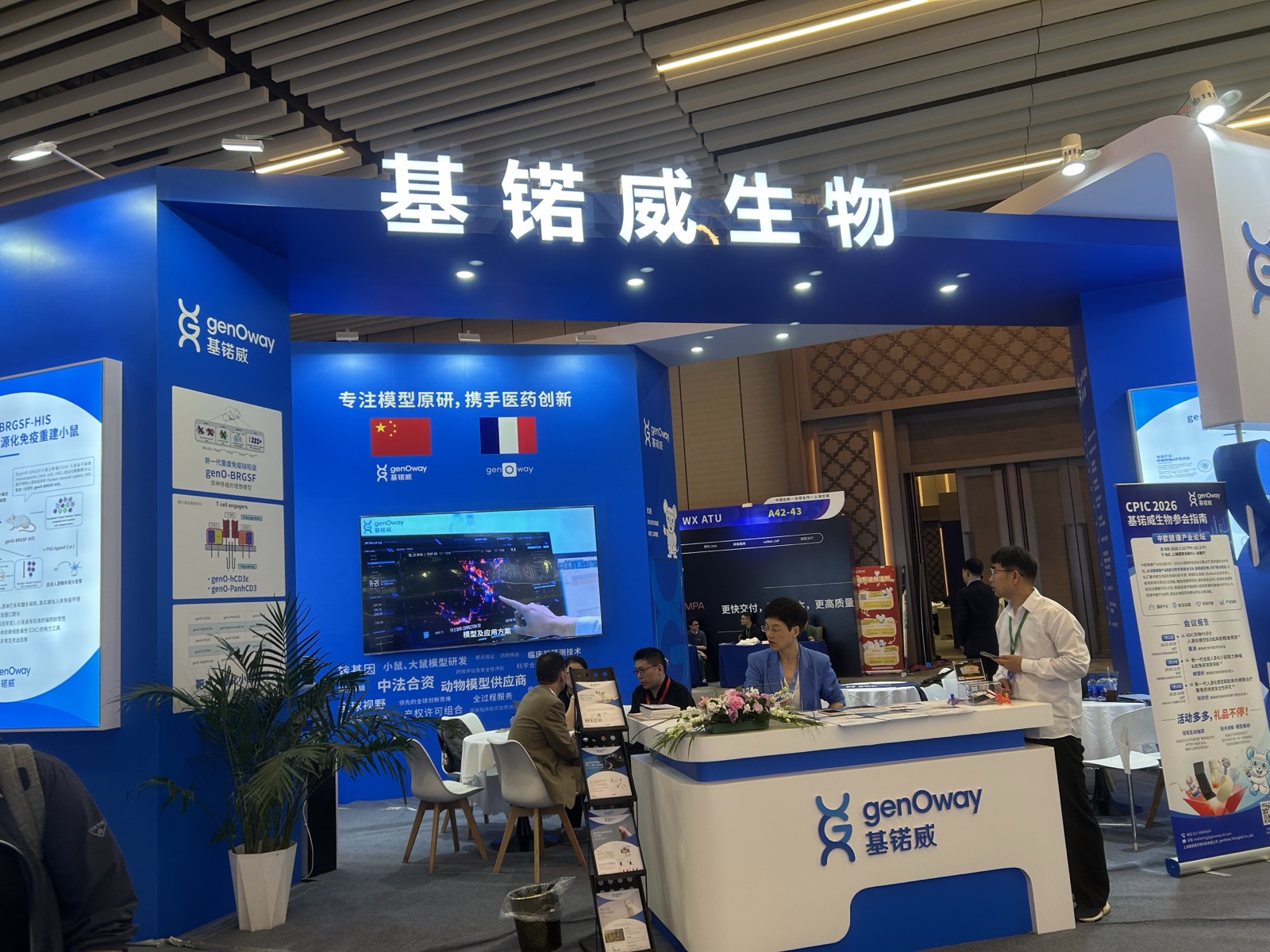
The exhibition floor told a complementary story. Alongside the Chinese biotechs and CDMOs exhibiting, we spent time at the booth of genOway, a French preclinical-models company that has spent the better part of a decade building out a China presence: a 2020 partnership with Cyagen to commercialize humanized mouse models across Asia-Pacific, then a full Sino-French joint venture, Shanghai Genoway Biotechnology, established in 2023. genOway's founder, Alexandre Fraichard, spoke at CPIC on precision animal models as "a critical foundation for China-Europe translation of breakthrough drug innovation." That's a clean example of a Western company embedding itself in China's R&D ecosystem to sell services rather than to license in a drug.
genOway wasn't alone. The exhibition halls were dense with domestic and international vendors alike: cell-therapy manufacturing, viral filtration, bioprocess equipment, all pitching into the same growth story. More Chinese biotech companies doing more R&D domestically means more demand for the tools, models, and services that make that R&D possible. That demand doesn't care whether the vendor is headquartered in Shanghai or Lyon.
Capital Markets Are Cooperating
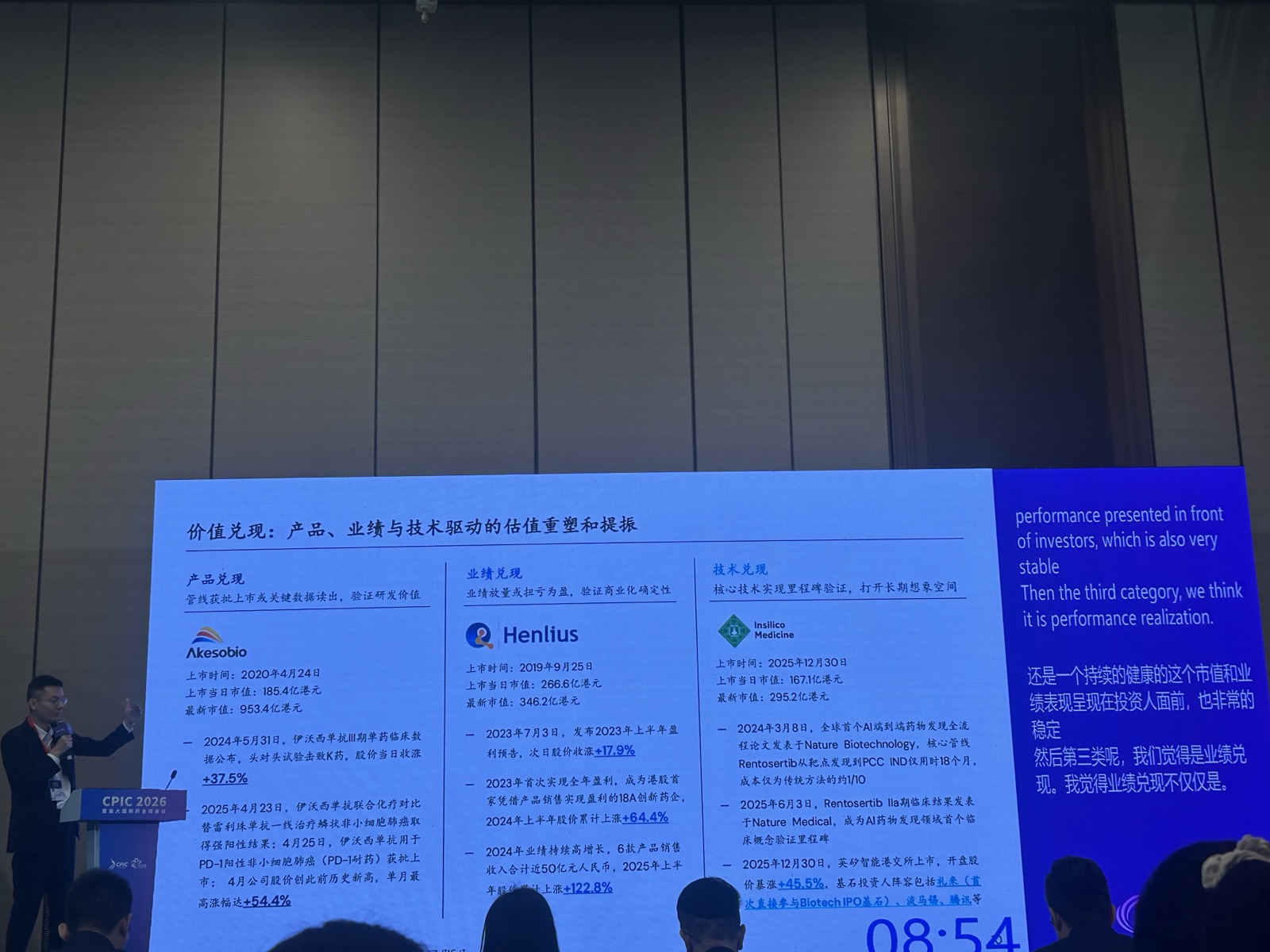
The other encouraging signal came from the Hong Kong listing sessions, where a data-dense panel walked through the recent performance of three Chapter 18A-listed biotechs: Akesobio, Henlius, and Insilico Medicine. The numbers are hard to argue with: Akesobio's market cap has grown roughly fivefold since its 2020 listing, helped by trial data that beat Keytruda head-to-head; Henlius became the first 18A-listed biotech to post a full-year profit; Insilico Medicine's December 2025 IPO opened up more than 45%, with Eli Lilly taking its first-ever direct cornerstone position in a biotech IPO, alongside Temasek and Tencent.
That performance sits on top of a genuine regulatory tailwind: Hong Kong's 2025 "Technology Enterprises Channel" reform streamlined 18A filings, and the exchange hosted roughly four times as many pre-revenue biotech listings in 2025 as it did in 2024. When the financing route improves at the same time the BD pipeline is accelerating, both halves of a biotech's value-creation story get easier. We'll cover this in more depth later in the series.
Where We Land
None of this makes CPIC the finished article. It's a first edition: some sessions were stronger than others, some of the scale claims deserve a second look, and it will take a few more years of consistent execution before "the JPM of Chinese pharma" is a description rather than an ambition. But the raw material is there. The audience was genuinely large and genuinely senior, with major multinational BD heads from Novo Nordisk, J&J, AbbVie, and Bayer taking speaking roles on stage. The domestic dealmaking wave is broader than outbound licensing alone. International service providers are actively building out China operations, and capital markets are, for the moment, rewarding the companies at the center of all of it.
We left Shanghai with a strengthened network and a clearer picture of where the next wave of China pharma BD activity is heading. Over the rest of this series, we'll unpack the cross-border deal data in more detail, look closer at the intra-China dealmaking trend, spend more time on what's happening on the exhibition floor, and cover the capital-markets and payer-side dynamics shaping how all of this gets financed and reimbursed. If CPIC's first year is any indication, this is a conference, and a market, worth watching closely.
For biotech partnering or asset strategy discussions, contact Kerlann Advisory.