China-Originated Innovation
Who Pays for Innovation? China's Commercial Insurance Puzzle
China just launched its first-ever commercial insurance catalogue for innovative drugs, weeks before CPIC 2026. Here's what it means for how a Chinese drug launch actually gets paid for.
Why we closed the series here
CPIC 2026 ran three sessions on healthcare payment and insurance: commercial health insurance broadly, a new-type group insurance product aimed specifically at innovative-drug payment, and a comparative look at Japan's insurance system. We closed this series here deliberately. Every deal, listing, and exhibition booth covered in the previous five articles eventually depends on someone actually paying for the drug once it launches, and China just rewrote a meaningful part of that answer weeks before this conference happened.
The Ceiling NRDL Can't Clear
China's basic medical insurance drug list, the NRDL, works through what Chinese industry calls "soul-searching negotiation": manufacturers accept steep price cuts, an average of 63% off list price in the 2024 cycle, in exchange for guaranteed national reimbursement volume. It's an effective mechanism for broad access, and 89 of 117 drugs that entered negotiation succeeded that year. But it has a hard ceiling. Genuinely expensive, genuinely innovative therapies (CAR-T products, some rare-disease treatments, an Alzheimer's drug among them) either can't clear the price bar the negotiation demands or don't fit the "basic" insurance mandate at all. Historically, those drugs launched in China with minimal reimbursed volume or didn't launch commercially at meaningful scale. Patients paid out of pocket, or didn't get the drug.
A New Third Tier, Launched Weeks Before CPIC
On December 7, 2025, China's National Healthcare Security Administration and the Ministry of Human Resources and Social Security jointly released something that had never existed before: a dedicated Commercial Health Insurance Innovative Drug Catalogue, alongside the routine NRDL update, both effective January 1, 2026. Chinese industry has already nicknamed it "Category C," a third tier alongside the NRDL's basic-insurance Categories A and B, built specifically to catch high-value drugs that exceed what basic medical insurance can afford.
The first edition lists 19 drugs from 18 companies: nine Class 1 innovative new drugs, treatments for six rare diseases, five oncology drugs described in Chinese coverage as "million-yuan-class," including CAR-T and bispecific antibody therapies, plus an Alzheimer's drug. Basic medical insurance funds don't pay for anything on this list, and regulators deliberately excluded Category C prescriptions from the hospital KPIs that normally discourage doctors from prescribing expensive drugs, a specific design choice meant to stop hospitals from avoiding these drugs to protect their metrics. Perhaps more significant for how BD teams should think about a China launch going forward: the Category C and NRDL negotiation tracks now run on largely the same timeline, and a drug can move between them. The explicit policy intent is a staged pathway. Launch commercially first, build real-world usage data and bring down unit costs at scale, then graduate into basic NRDL reimbursement once that evidence exists.
Commercial insurance payouts for innovative drugs and devices reached RMB 15.2 billion in 2025, up 23% year on year, roughly double the RMB 7.4 billion figure an earlier industry white paper reported for 2023. We couldn't pin the RMB 15.2 billion figure to a single clean primary source, so treat it as directionally solid rather than precise. The trajectory, not the exact number, is the point.
What This Looks Like on the Ground in Shanghai
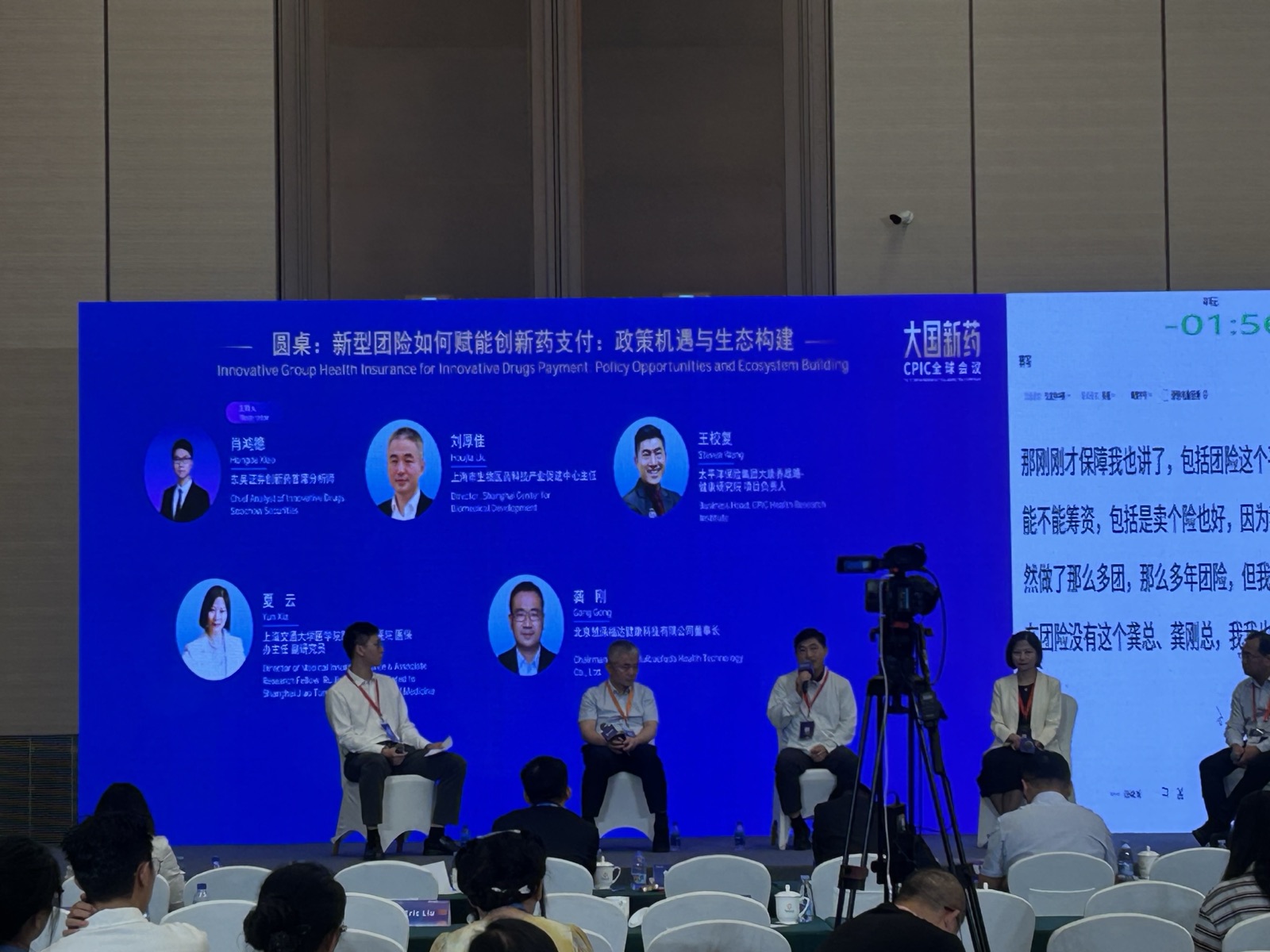
The CPIC 2026 panel on "new-type group insurance" was describing a specific, dated mechanism, not a generic policy trend, and understanding it explains exactly why the panelists on stage were the panelists on stage.
In August 2025, Shanghai's financial regulators and medical insurance bureau jointly released a package, widely reported as the city's "new 18 measures," that lets employees' individual medical insurance personal accounts pay premiums for employer-sponsored group health insurance, with coverage extending to immediate family members. Unlike traditional group insurance, which mostly tops up a patient's out-of-pocket cost on treatments already covered, this product is designed to cover drugs entirely outside basic medical insurance, settling in real time at the point of care rather than through a separate claims process after the fact. The initial formulary target is more than 80 innovative drugs, roughly double the drug variety of Shanghai's existing city-level inclusive insurance program. Three insurers formed the alliance behind it: Pacific Health Insurance, Ping An Health Insurance, and China People's Health Insurance. Pacific Health Insurance does business as CPIC Health, and its research institute's business head, Steven Wang, is exactly who sat on the CPIC 2026 panel. That's the direct, mundane explanation for why that panelist was there.
It's worth pausing on a genuinely confusing coincidence for a Western reader skimming quickly: "CPIC" here has nothing to do with CPIC 2026, the conference this entire series covers. CPIC Health is a subsidiary of China Pacific Insurance Company, a 30-plus-year-old composite insurer listed in Shanghai, Hong Kong, and London, with roughly 180 million customers and no corporate relationship whatsoever to the pharma conference sharing its acronym. Two unrelated organizations, one four-letter coincidence, and a conference program that presumably knew exactly what it was doing when it invited an insurer called CPIC to speak at CPIC.
The Shanghai pilot's funding source is worth noting on its own. The city's accumulated medical insurance personal-account balances total more than RMB 200 billion, described in Chinese coverage as idle capital the new mechanism is designed to activate. Estimates for the pilot's own scale vary widely, from a conservative RMB 500 million to RMB 1 billion in annual premium up to a government aspirational target of 3 million policies a year, a wide enough range that the honest read is: this is a real, funded, named pilot, not yet a program with settled numbers.
Why This Should Change How You Model a China Launch
The old China commercial calculus for an innovative drug was close to binary: clear NRDL negotiation and accept a deep price cut for large guaranteed volume, or accept a small cash-pay market and plan around it. Category C, the Shanghai group insurance pilot, and the broader city-level inclusive insurance programs it builds on together create something that didn't really exist before: a genuine middle tier, premium pricing sustained by commercial payers, a real if smaller reimbursed population, and an explicit, government-built on-ramp to basic NRDL reimbursement once usage data justifies it. For a BD team modeling a China launch or evaluating an in-license from a Chinese partner, that changes the planning question from "will this clear NRDL" to "what does a staged commercial-then-basic launch look like, and how fast can we move between the two." Chinese commentators describe the destination as "医保托底、商保分层," medical insurance as the floor, commercial insurance layered on top. That's now a policy structure with a specific catalogue, a specific pilot, and a specific effective date behind it, not an aspiration.
A Shorter Note on the Japan Comparison
CPIC 2026 also included a talk on Japan's medical insurance system, delivered by an executive from Toho Holdings, a major Japanese pharmaceutical wholesaler that, not coincidentally, operates a joint venture with a Chinese distributor to bring Japanese and other foreign products into Chinese hospitals. The comparison itself is a genuine one Chinese health-policy analysts draw regularly, not conference filler: Japan reached universal coverage decades before China and is roughly 20 to 30 years further into the population aging that's now pressuring China's own system, making Japan's price-negotiation and generic-substitution machinery a preview of tools China is still building out. We independently confirmed Japan's national medical costs at roughly ¥45 trillion for 2021 and its drug market's position as the world's third-largest as of 2016, both consistent with what was presented. We couldn't independently verify several more granular figures cited at the conference (generic-substitution share, wholesaler count, the split between domestic and foreign manufacturers), so we're attributing those to the conference presentation rather than presenting them as confirmed.
Closing the Series
We opened this series calling CPIC 2026 a modest, promising first edition of a conference explicitly built to become China pharma's answer to JP Morgan Healthcare. Six articles later, the case looks stronger, not weaker, than it did on day one. The BD data holds up under verification, with corrections where it didn't. The intra-China dealmaking wave is real and under-covered. Hong Kong's capital markets are genuinely working again. International service providers are building real infrastructure, not just booths. And the payer system, the least glamorous part of the story and the one that determines whether any of the rest of it turns into revenue, is being rebuilt in real time, on a timeline that happened to land right around this conference. None of that guarantees CPIC becomes what its organizers want it to become. But we came away from Shanghai with a strengthened network and a genuine conviction that this is a market worth tracking closely, and we hope this series gave you enough to start doing that yourself.
For biotech partnering or asset strategy discussions, contact Kerlann Advisory.