China-Originated Innovation
133 Deals, Falling Value: China's Quiet Domestic BD Boom
China's outbound licensing wave gets all the coverage. A record 133 domestic deals in 2025 tell a quieter, and in some ways more important, story about where China pharma BD is headed.
Beyond the outbound headlines
The first article in this series flagged a thread we thought was underappreciated: Chinese pharmaceutical companies doing deals with each other, alongside the outbound licensing wave that dominates the headlines. We named three examples then. This piece goes deeper, and the data turned out sharper than we expected.
The Record Nobody's Reporting
Every outbound-licensing tracker gets cited constantly: $137.7 billion in 2025, deal after deal with Western pharma. Far fewer trackers cover the deals happening entirely within China, and the ones that do tell an interesting story.
Domestic ("境内") deal count hit 27 in the first quarter of 2025 alone, up 59% year on year. By the end of the third quarter, the domestic deal count for the year had already passed the *full-year* total for 2024. By the time the year's data was in, the final count reached 133 domestic deals, a new record.
Here's the twist. Disclosed total value for those 133 deals fell year on year, even as the count climbed. More than half, 51%, were preclinical-stage transactions: smaller, earlier assets rather than the large, late-stage tickets that dominate outbound headlines. Domestic dealmaking is growing in a different shape than outbound licensing, skewing toward volume and early-stage assets rather than blockbuster tickets. That says something about where the next generation of Chinese drug assets is likely to originate: inside China's own deal ecosystem, well before they're mature enough for a Western licensing conversation.
One caution on the exact figures. The specific dollar totals reported for different measurement windows in 2025 don't fully reconcile against each other in the sources we found, likely a function of different cutoff dates and what counts as "disclosed." The directional story, record deal count and declining disclosed value, is well supported. The precise dollar figures should be treated as approximate.
The Deals Behind the Numbers
Domestic dealmaking splits into two recognizable patterns: licensing deals where one Chinese company brings in another's asset for the China market, and outright acquisitions where one Chinese company buys another.
On the licensing side, Hengrui Pharma's December 2025 deal with Hansoh Pharma set the template we described in Article 1: a domestic license for an early-stage asset, modest upfront payment, milestone-heavy structure. CSPC Pharmaceutical followed a similar shape at larger scale. Through its subsidiary Shanghai Jinmante Biotech, CSPC licensed in JSKN003, a HER2 bispecific-epitope ADC, from Jiangsu Alphamab for the China market: RMB 400 million upfront, up to RMB 830 million in development milestones, up to RMB 1.85 billion in sales milestones, for a total potential value around RMB 3.08 billion. JSKN003 received NMPA Breakthrough Therapy designation in March 2025. This is one of China's largest pharma companies licensing in a domestic biotech's late-stage oncology asset, purely for the domestic market, with no Western counterparty anywhere in the structure.
One licensing deal is worth flagging for a different reason: it shows domestic and outbound dealmaking aren't always separate universes. Miracogen, one of China's most prolific outbound ADC licensors with deals already signed with BioNTech and Avenzo, also licensed a HER2 ADC, DB-1303/BNT323, to Sansheng Pharma (3SBio) for Greater China rights: $25 million non-refundable upfront, up to $42 million in R&D milestones, plus additional sales milestones. The same underlying asset is being sliced into a Western deal and a domestic deal by the same originator, in parallel. That pattern is worth watching. It suggests the strongest China-originated assets increasingly get diversified across both markets rather than committed exclusively to one.
On the acquisition side, Sino Biopharmaceutical's roughly $950 million purchase of LaNova Medicines, covered in Article 1, was not the largest domestic control transaction of the period. That distinction belongs to China Resources Sanjiu's acquisition of a 28% stake in Tasly Pharmaceutical for RMB 6.211 billion, roughly $860 million, making China Resources the controlling shareholder and shifting Tasly's ultimate ownership to a central state-owned enterprise. Chinese trade coverage frames the deal as consolidating China Resources' position across the full traditional Chinese medicine supply chain, absorbing Tasly's cardiovascular-focused TCM portfolio and its certified growing bases. It's a useful reminder that domestic consolidation isn't only an innovative-drug story. State-owned enterprises are running their own parallel consolidation track.
Not every domestic acquisition is a clean win. Fosun Pharma paid RMB 1.412 billion in December 2025 for a 51% controlling stake in Lvgu Pharmaceutical, buying into GV-971, a conditionally approved Alzheimer's drug whose underlying trial data and mechanism drew real scientific controversy after its 2019 approval and were part of why it was later pulled from production. Fosun's stated rationale is funding the confirmatory post-market trial the drug needs for full re-registration. Whether that bet pays off is genuinely uncertain. We're including it because a healthy domestic BD market includes speculative, contested bets alongside the obvious winners, not because we're confident in the outcome.
A third strand of consolidation is happening one level removed from drug assets entirely: distribution. Guangzhou Pharmaceutical, a subsidiary of the Baiyunshan group, agreed in December 2025 to buy Zhejiang Pharmaceutical Industrial Company outright from Zhejiang Hisun Pharmaceutical for RMB 501 million, a 42% premium over book value, folding a provincial wholesale network covering 90% of county-level and above hospitals into Guangzhou Pharma's own distribution footprint. Chinese trade press described it alongside a parallel move by a Jiangsu-based distributor expanding north, framing both as part of a broader cross-province wave in pharma wholesale. It's a less glamorous story than an oncology ADC license, but it's the same underlying dynamic at work: Chinese pharma companies buying capability from each other rather than only building it themselves or importing it from abroad.
The AI-Native Sub-Theme
One pattern in the data is worth calling out on its own: domestic dealmaking is disproportionately driven by China's AI-native drug discovery companies doing multiple smaller technology tie-ups rather than single large asset licenses. XtalPi alone completed four domestic deals in the first three quarters of 2025. Insilico Medicine signed at least two in the same period: a February 2025 collaboration with Harbour BioMed combining antibody-discovery and AI drug-design platforms for oncology, immunology, and neuroscience targets, and a March 2025 tie-up with Miwell Biotech on AI-enabled ADC discovery that later expanded into a three-way collaboration with Bide Pharmatech.
Neither deal disclosed dollar terms, which is itself part of the pattern. These are platform and technology-sharing arrangements, not asset licenses with milestone schedules attached. If the large single-asset deals from Hengrui, CSPC, and the acquisitions above are one face of domestic BD, this is the other: smaller, more numerous, and increasingly AI-driven, exactly the kind of activity that shows up in a deal-count statistic without moving a deal-value statistic much at all.
CPIC Is Already Building This Into the Agenda
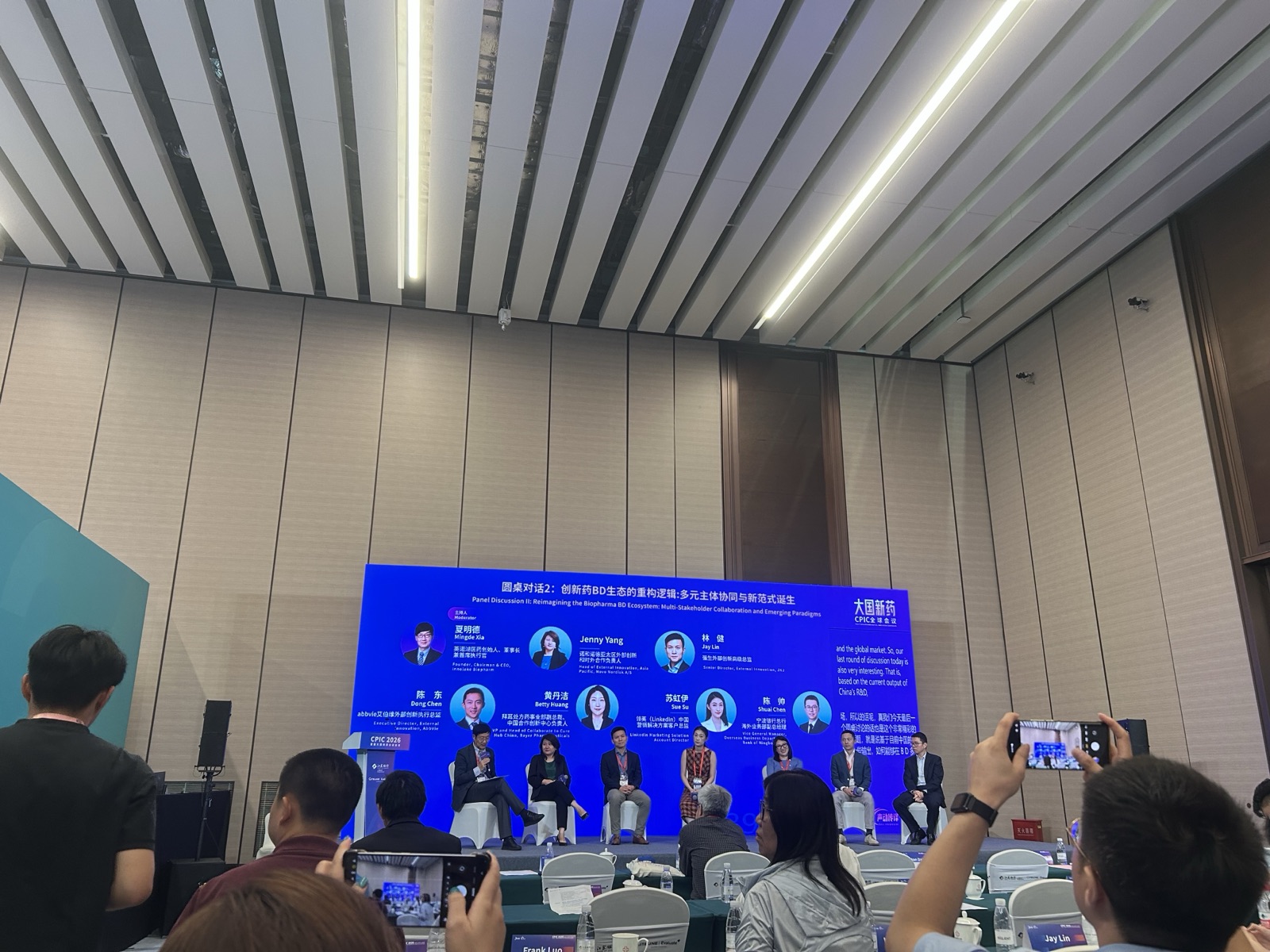
CPIC's own program included a panel that reads like a direct acknowledgment of this trend: "Reconstructing the Logic of the Innovative Drug BD Ecosystem: Multi-Stakeholder Synergy and the Birth of a New Paradigm," moderated by Mingde Xia, founder and CEO of InnoLake Biopharm. The panel put Novo Nordisk's Jenny Yang, J&J's Jay Lin, AbbVie's Dong Chen, and Bayer's Betty Huang on stage alongside Shuai Chen of Bank of Ningbo, an unusual pairing of MNC external-innovation heads with a Chinese commercial bank.
We couldn't find a recap of what was actually said in that room. Every source we located describes the planned agenda, not the discussion, and it's a reminder that CPIC's own conference-recap culture still runs mostly through WeChat rather than indexed press coverage. What the lineup itself tells you is that CPIC's organizers built a session explicitly framed around multi-stakeholder BD synergy, with a bank in the room alongside four global pharma external-innovation leads, rather than a conventional outbound-licensing panel. That's a fair signal that the conference sees the ecosystem question as more complex than "China licenses out to the West," even if we can't yet tell you what was said about it on stage.
What This Means for Anyone Watching From Outside
If you're a Western BD team tracking China only through outbound licensing announcements, you're seeing roughly half the picture, and not the half that tells you where the next generation of assets is coming from. A record year for domestic deal count, concentrated in earlier-stage assets and increasingly driven by AI-native platform companies, points toward a China pharma ecosystem that's maturing its own internal capital allocation, not just packaging finished assets for export. Some of the 133 domestic deals signed in 2025 will be the outbound deals of 2027 or 2028. Knowing which ones, and why, is exactly the kind of intelligence that doesn't show up in a headline deal-value tracker.
For biotech partnering or asset strategy discussions, contact Kerlann Advisory.