China-Originated Innovation
Hong Kong Is Back: How 2025's IPO Reforms Are Refinancing Chinese Biotech
A regulatory reform, a wave of 18A listings, and two CPIC panels of the people structuring these deals. Here's what's actually driving Hong Kong's comeback as Chinese biotech's financing engine.
Three stocks, one hour
The first article in this series mentioned three stock charts from a CPIC 2026 Hong Kong listing panel: Akesobio, Henlius, and Insilico Medicine, all up sharply since their IPOs. This piece looks at what's driving that performance, what changed in the market structure behind it, and what the bankers and lawyers actually structuring these listings said on stage.
The Reform Behind the Surge
Hong Kong's Chapter 18A listing rules, introduced in 2018, let pre-revenue biotech companies go public, something most exchanges still don't allow. For years the rule existed without producing much volume: by mid-2025, only around 73 companies had used it in seven years. That changed sharply in the second half of 2025. The exchange hosted 14 to 17 pre-revenue biotech listings that year, roughly four times 2024's count of four, part of a broader 2025 healthcare cohort of 27 listed companies. By this year, the cumulative 18A count had climbed to somewhere between 86 and 90 companies, having raised a combined HK$142.9 billion in total since the rule's introduction. We don't have a precise breakdown of how much of that total came from the 2025 surge specifically, but the jump from roughly 73 to the current 86-to-90 range in about a year, after seven years to reach the first 73, gives a sense of how concentrated the recent activity has been.
The proximate cause is a specific regulatory change. In May 2025, the Hong Kong Stock Exchange and the Securities and Futures Commission launched the Technology Enterprises Channel, streamlining the filing process for 18A biotech issuers and 18C specialist-tech issuers, including an option for confidential, pre-vetted filing before a company commits to a public listing timeline. Law firms and bankers who cover the market consistently credit this reform with accelerating the 2025-2026 listing wave, not merely improving sentiment around it. The pipeline behind it looks similarly full: six more 18A listings in the first five months of 2026, roughly 31 companies working toward 18A listings and 16 more toward 18C, and KPMG's own projection of 80 to 100 total Hong Kong IPOs in 2026, with total proceeds potentially exceeding HK$200 billion.
Biotech listings are one part of a broader Hong Kong IPO recovery, not an isolated bright spot. The exchange hosted 117 total IPOs across all sectors in 2025, raising roughly HK$280 billion. Two of the 2025 healthcare listings earned their own category-defining labels in Chinese financial press: NeuroXess, described as the "first digital therapeutics stock," and Visen Pharmaceuticals, the "first growth and development disorder stock." Neither is a household name outside China, and that's the point. A market only produces first-of-category listings like these once there's enough depth for genuinely novel business models to find willing investors, not just proven ones.
Three Stocks, One Signal
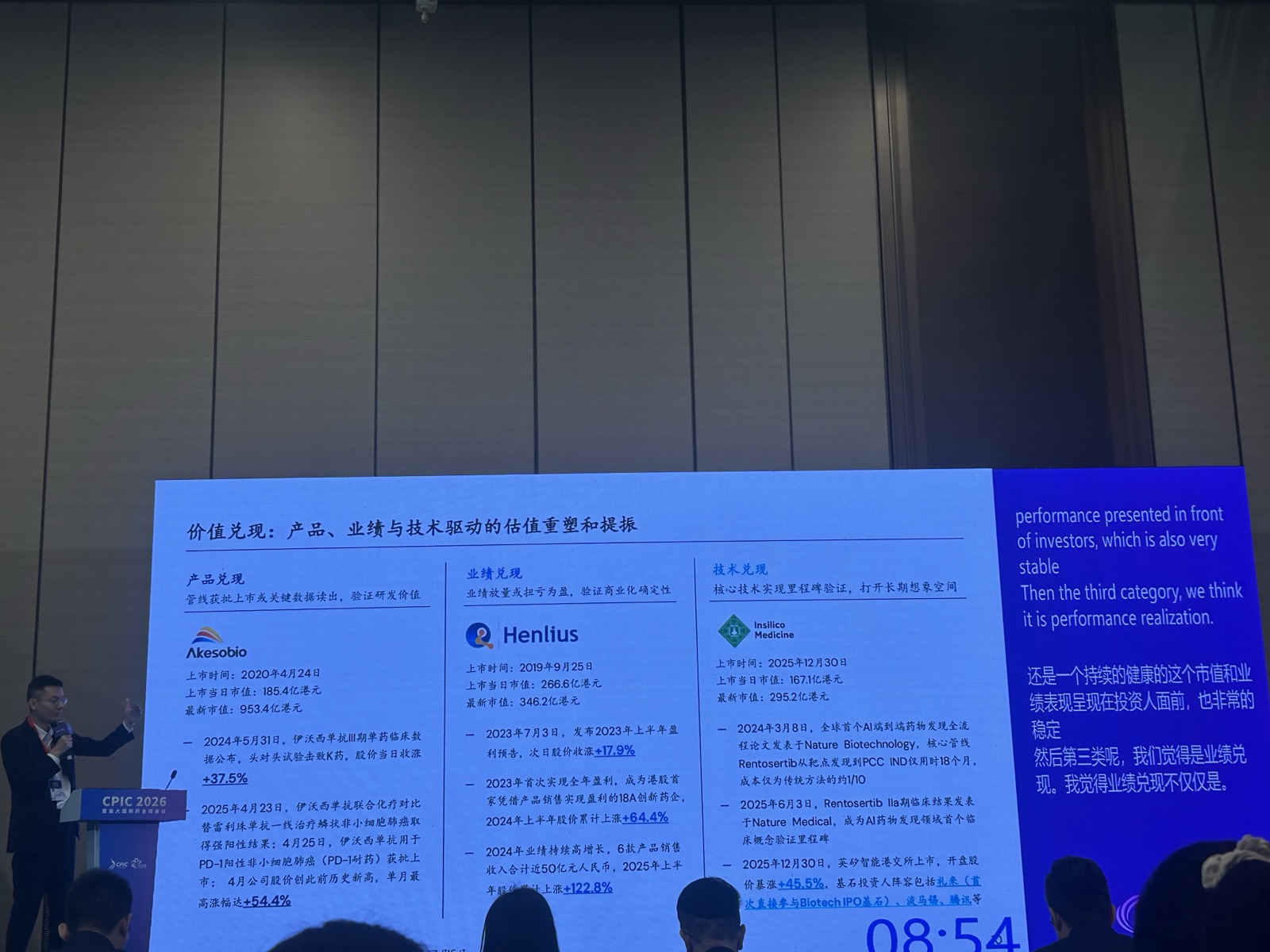
The data slide behind the panel we referenced in Article 1 told a consistent story across three very different companies.
Akesobio listed in April 2020 at a day-one market cap of HK$18.5 billion. Its current market cap, roughly HK$95.3 billion, is close to fivefold that starting point, driven by clinical results rather than sentiment: its ivonescimab data beat Keytruda head to head in a Phase 3 readout in May 2024, sending the stock up 37.5% in a single day, and a further combination-therapy readout in April 2025 pushed the stock's monthly gain as high as 54.4%. The pattern is consistent: every major re-rating traces to a specific clinical data release, not general market sentiment.
Henlius listed in September 2019 at a day-one market cap of HK$26.7 billion, now HK$34.6 billion, and became the first 18A-listed biotech to post a full-year profit, in 2023, a milestone that matters because it demonstrated the model itself works, not only the science behind any one drug. By 2024, six commercialized products were generating combined revenue of nearly RMB 5 billion, and the stock gained a further 122.8% cumulatively through the first half of 2025.
Insilico Medicine listed most recently, in December 2025, opening up more than 45% on its first day, at a market cap that has since grown from HK$16.7 billion to HK$29.5 billion. Its cornerstone investor list is unusual for a biotech IPO: Eli Lilly took its first-ever direct cornerstone position in a biotech listing, alongside Temasek and Tencent. The underlying pitch to those investors is a specific one. Insilico's Rentosertib, developed with an AI-driven discovery process the company published in Nature Biotechnology, went from target discovery to preclinical candidate in eighteen months at roughly a tenth of traditional development cost, and its Phase IIa results, published in Nature Medicine in June 2025, are being cited as AI drug discovery's first real clinical proof-of-concept milestone.
Those three companies aren't the only signal worth watching. Hengrui Pharma, mainland China's largest listed pharmaceutical company by most measures, completed its own Hong Kong dual listing at a market cap of roughly HK$320 billion and a price-to-earnings ratio near 32. A company of Hengrui's scale choosing to add a Hong Kong listing, rather than needing Hong Kong to raise its first capital, is a different kind of vote of confidence than a pre-revenue biotech's IPO. Hong Kong's recovery is becoming a venue that China's most established pharma companies actively choose, not only a financing option for companies that couldn't list anywhere else.
What the People Structuring These Deals Actually Said
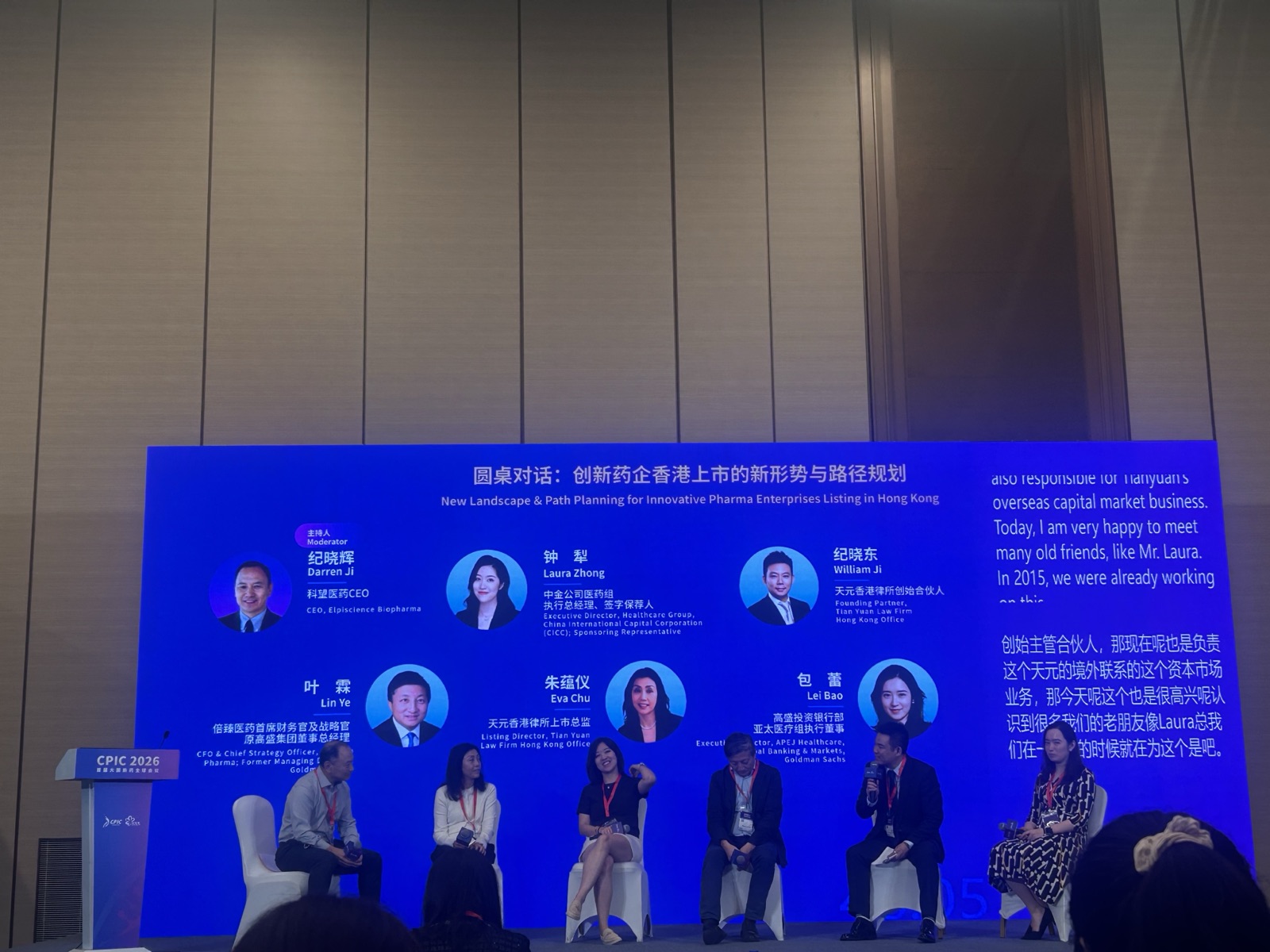
Both HK listing sessions at CPIC included live English interpretation, captured on screen, giving us actual quotes rather than secondhand summaries. The six-person panel itself was a useful cross-section of who actually structures these listings: Darren Ji, CEO of Elpiscience Biopharma, moderating from the biotech side; Laura Zhong of CICC as sponsoring representative; Lei Bao of Goldman Sachs representing the international banking side; and both William Ji and Eva Chu from Tian Yuan Law Firm's Hong Kong office covering the legal structuring. A biotech CEO chairing a conversation between a domestic bank, an international bank, and outside counsel is itself a small signal of how integrated the ecosystem around these listings has become.
William Ji, founding partner of Tian Yuan Law Firm's Hong Kong office, opened his remarks by placing the current wave in a longer context: "In 2015, we were already working on this," he said, describing Tian Yuan's overseas capital markets practice. That's a useful data point on its own. The firms now benefiting from the 2025 surge didn't spring up to meet it. Some of them, at least, built the underlying capability across the previous decade and were positioned when the reform hit.
Chenming Xu, head of international business for CITIC Securities' healthcare investment banking group, framed his own talk, titled "Reshaping and Breakthrough: Hong Kong Stock Listing Review and Issuance Dynamics Under the New Cycle," around the scale of the shift: "In recent years, the whole market has undergone a particularly big change," he said, noting that earlier speakers at the conference had already covered much of the Hong Kong story from their own angles. That kind of overlap, several bankers and lawyers independently choosing to address the same market shift at the same conference, is itself a signal that this is the topic the room came to hear about.
What This Means for Biotechs Weighing Their Options
For a Chinese biotech deciding where to raise its next round of capital, the calculation has shifted meaningfully since 2024. A faster, more predictable filing process, a deeper pool of comparable recent listings to price against, and cornerstone investors like Eli Lilly now willing to anchor a Hong Kong IPO all reduce the execution risk that used to make founders default to a private financing round instead. The confidential pre-vetted filing option matters more than it might sound like on paper: it lets a company test the exchange's appetite for its story before committing to a public timeline, which means a company that isn't ready doesn't have to withdraw a filing in public view, a scenario that used to discourage marginal candidates from trying at all.
None of this makes Hong Kong a sure thing for every company. Listing still requires real commercial or clinical proof points, as Akesobio's and Henlius's post-IPO trajectories show. But the venue itself is working again, in a way it clearly wasn't a few years ago, and the pipeline of companies lining up behind Hengrui and Insilico Medicine suggests the people closest to these deals expect that to continue.
For biotech partnering or asset strategy discussions, contact Kerlann Advisory.