China-Originated Innovation
When the World Comes to China: Inside CPIC's International Exhibition Floor
The BD deal flow between China and the West gets all the attention. A quieter trend is playing out on the exhibition floor: Western companies building real operations inside China's R&D ecosystem.
A pattern beyond the deal data
The first article in this series mentioned genOway, a French preclinical-models company we found exhibiting at CPIC 2026. This piece goes deeper into that story, and into the broader exhibition floor around it, because it's evidence of a pattern that gets much less coverage than outbound licensing deals: Western companies building real, on-the-ground operations inside China's biotech ecosystem, to sell services rather than to license in a drug. The first two articles in this series covered how deals get done, both across borders and within China itself. This one covers who's building the infrastructure those deals depend on, and why a French company with no obvious need for a China presence decided to build one anyway.
A Six-Year Build
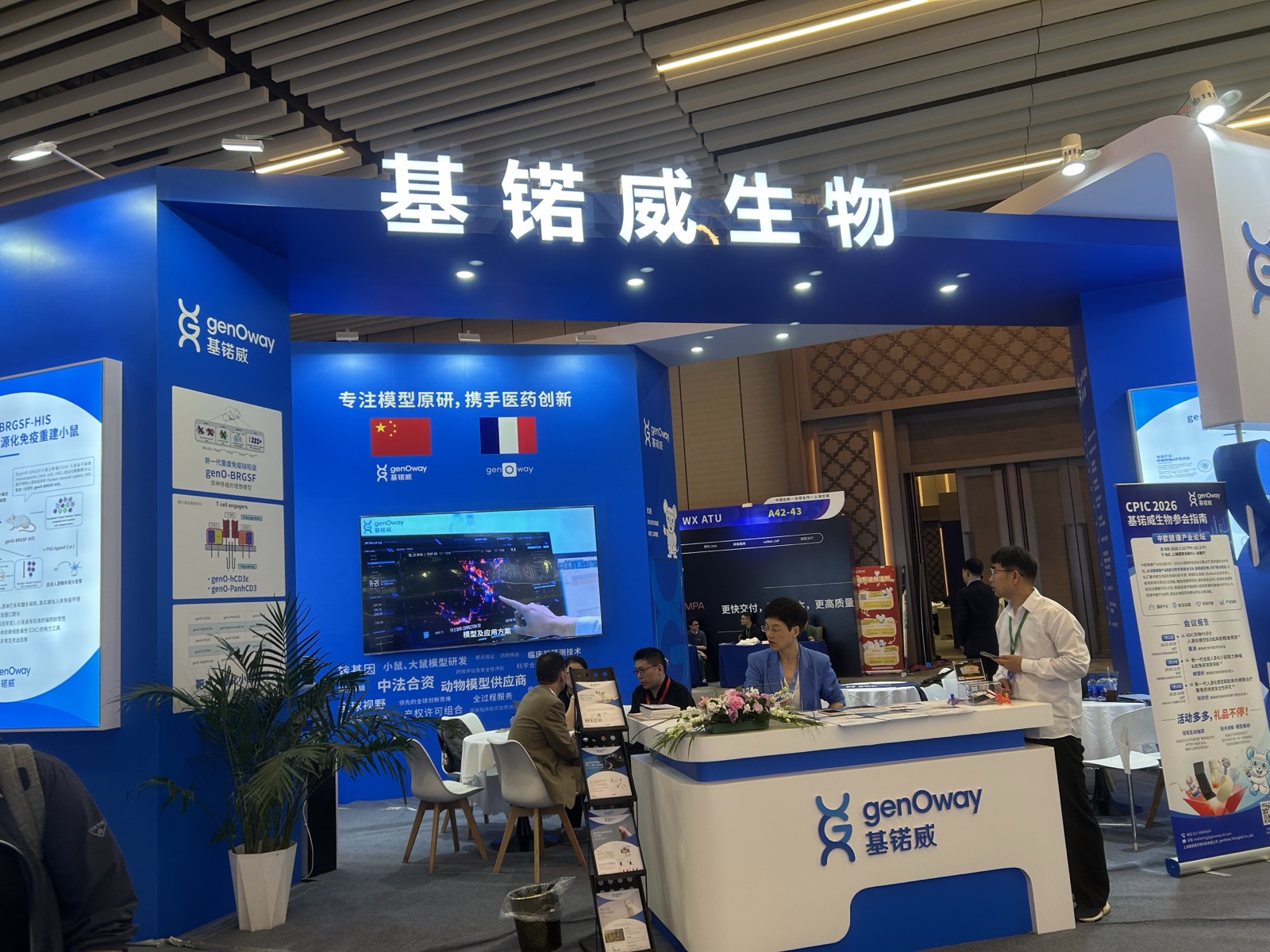
genOway's presence at CPIC wasn't a one-off marketing trip. It's the latest step in a deliberate, multi-year build.
The company, founded in Lyon in 1999 and listed on Euronext Growth Paris, built its business on genetically engineered mouse and rat models for drug target validation and efficacy testing, holding exclusive licenses to core CRISPR/Cas9 patents from Merck/Sigma-Aldrich, UC Berkeley, and the Broad Institute. Its customer base, 380 academic institutions and 170 life-sciences companies globally, including 17 of the world's top 20 pharmaceutical companies, is exactly the kind of blue-chip client list most companies would be content serving from Europe alone.
The build happened in three steps, each one a bigger commitment than the last. In 2020, genOway partnered with Cyagen, an existing China/US genetically-engineered-rodent-model company, to commercialize humanized immune-checkpoint and immunodeficient mouse models across the Asia-Pacific region. Cyagen already had the regional distribution relationships; genOway supplied the models. It's a lighter-touch arrangement that let genOway test the market without committing capital to a standalone entity, and choosing a partner that already bridged the China and US markets meant genOway didn't have to build that bridge itself on the first attempt.
In 2023, genOway went further, establishing Shanghai Genoway Biotechnology, a dedicated Sino-French joint venture based in Pudong, building what the company describes as a complete local animal-model production and quality-control system. That's the step that changes the economics: production done locally is priced for the local market and delivered on local timelines, rather than shipped from France. By 2026, that JV had its own booth at CPIC, staffed and branded as a Chinese entity, "基锘威生物," with the parent company's French identity displayed alongside rather than in place of it. genOway's founder and CEO, Alexandre Fraichard, had a speaking slot on precision animal models as "a critical foundation for China-Europe translation of breakthrough drug innovation," and the booth itself displayed its specific product lines: humanized immune-checkpoint models, T-cell engager tools, and a suite of named platforms (genO-hCD3ε, genO-PanhCD3, genO-hOX40 among them) built for exactly the immuno-oncology and bispecific-antibody work driving China's current BD wave.
Each step increased genOway's exposure to the China market and its operational commitment there. A partnership costs little to unwind. A joint venture with local production infrastructure, staff, and regulatory filings behind it does not. Six years in, genOway isn't testing the water anymore, and reversing course at this point would cost real money and real time, exactly the kind of commitment a skeptical observer would want to see before believing a company's China strategy is more than a press release.
The Demand Side of This Trade
genOway's bet only makes sense if the underlying demand is real, and the deal data from earlier in this series suggests it is. China's innovative-drug companies are filing more than 600 INDs a year, the highest density globally across oncology, metabolic disease, and autoimmune conditions, according to the BD workshop data we covered in Article 2. Every one of those programs needs preclinical validation work: animal models, target confirmation, safety and efficacy testing, before it can reach a clinical trial application. More domestic R&D activity means more demand for exactly the kind of infrastructure genOway sells.
That demand doesn't stop at the preclinical stage. Article 2 also noted that China's ADC manufacturing capacity now leads the world, with a 30-50% CDMO cost advantage over Western manufacturing. That kind of manufacturing scale doesn't run on domestic supply chains alone; it runs on specialized inputs like viral-filtration membranes and bioprocess equipment, much of which is imported or produced locally by exactly the kind of international vendors exhibiting alongside genOway. The preclinical-tools demand and the manufacturing-scale story aren't two separate trends. They're upstream and downstream halves of the same growth curve.
The vendor doesn't need to be Chinese to serve that demand. It needs to be present, responsive, and priced competitively for the China market, which is precisely what a local joint venture with local manufacturing delivers and a France-based export relationship cannot. genOway's three-step build looks less like an unusual outlier and more like a rational response to where its own customers are increasingly doing their earliest-stage work.
Other Vendors, Same Underlying Pattern
genOway wasn't competing in a vacuum, and the rest of the exhibition floor reinforced the same demand from different angles. Vital River, one of China's own largest lab-animal-model providers, exhibited at CPIC too, occupying the same broad category of business as genOway rather than a different one entirely. That's a useful check on the narrative: the market is large enough, and still growing fast enough, that domestic and international specialists are competing for the same customers side by side, rather than Western vendors simply filling a gap domestic suppliers can't reach. That kind of head-to-head competition is a healthier signal for the underlying demand than either group operating unopposed.
FDCELL, a cell and gene therapy manufacturing specialist, showed automated production and medical-device certification services for cell therapy developers, alongside SGS certification support, positioned squarely at the manufacturing bottleneck that's slowed cell therapy commercialization globally. Nearby booths from Altruist and Toffon covered adjacent parts of the same supply chain. Alioth's booth focused on virus-filtration membranes for biologics manufacturing, claiming its Alipore EZ sterilizing-grade filters are already qualified across more than 80 molecules from Phase 3 through commercial production, infrastructure-level evidence that China's biologics manufacturing base has matured well past early-stage capability. A third booth, presenting under the banner "Bioprocess Window," offered one-stop bioprocess solutions and lab equipment aimed at exactly the kind of scale-up problem a growing biotech runs into once its preclinical work succeeds.
The domestic side of the floor made the same point from the opposite direction. Guangzhou Pharmaceutical Holdings, part of the Baiyunshan group and a genuine Global 500 company, ran a prominent presence with its own ranking callouts displayed, while attendees carried branded tote bags from ChemPartner, a major Chinese CRO, between halls named things like "1-on-1 Business Zone" and "Silk Road Hall." The exhibition wasn't a scrappy trade show bolted onto a conference agenda. It was built at the scale of the ecosystem it was representing, with domestic giants and international specialists sharing the same floor plan.
None of these companies are licensing in a Western drug or licensing out a Chinese one. They're selling picks and shovels into a gold rush that both outbound licensing and intra-China dealmaking, the subjects of the previous two articles in this series, depend on happening somewhere first.
Some earlier waves of China market entry earned a fair criticism: token offices set up mainly for PR purposes, with little real capability behind them. genOway's investment looks different by design: a real production facility with quality-control infrastructure, and Alioth's claim of qualification across 80-plus molecules already in Phase 3 or commercial production, both require sustained technical and regulatory work that a nameplate office couldn't produce in a fraction of the time. The companies on this exhibition floor built something a competitor would need years to replicate, and years is exactly the head start genOway now has over any Western peer only beginning to consider the same move.
What This Means for Western Companies Watching From Outside
If your only mental model for engaging with Chinese biotech is licensing in an asset or licensing one out, the exhibition floor at CPIC is a reminder that there's a third option, and multiple companies are already executing on it. genOway's path is a specific, replicable template: start with a lighter partnership to test demand, convert to a local joint venture once that demand is confirmed, and use conferences like CPIC to establish visibility once the local infrastructure is in place to back it up. It took genOway six years to get from step one to a CPIC speaking slot. Companies starting that clock today won't have to invent the playbook. They just have to run it, and the tools, filtration, and bioprocess vendors sharing the floor with genOway suggest plenty of others already have.
For biotech partnering or asset strategy discussions, contact Kerlann Advisory.