China-Originated Innovation
Inside the $137 Billion Question: China's Cross-Border BD Machine, By the Numbers
A closer look at the deal structures, regulatory friction points, and named transactions behind CPIC 2026's headline BD numbers, checked against independent sources.
What the workshop covered
The first article in this series mentioned the headline numbers from BridgeBio Global CEO Tony Zhang's BD workshop at CPIC 2026: $137.7 billion in 2025 innovative-drug BD deal value, China's share approaching half, 157 outbound deals. This piece goes deeper into that same hour: the deal structures behind those numbers, the regulatory friction shaping them, and how each specific claim held up when we checked it against independent sources.
One note on method before the data. Zhang's slides are a workshop presenter's synthesis, not a peer-reviewed dataset. We verified every specific claim we planned to use. Most held up against multiple independent trackers. A few didn't, including two factual errors on the original slides. We've corrected those below rather than repeat them.
Two Compounding Advantage Sets
Zhang framed the US-China dynamic as "asymmetric integration," his term for a system where each side compounds a different set of advantages rather than competing head to head on the same axis.
China's advantages, in his telling: clinical enrollment speed roughly 2-3 times faster than the US, helped by GCP mutual recognition between regulators. ADC manufacturing capacity that leads the world, with a 30-50% CDMO cost advantage. More than 600 INDs filed per year, the highest global density in oncology, metabolic disease, and autoimmune conditions. Early-stage development costs running at a third to a fifth of US levels.
The US side keeps the advantages that are harder to build quickly: first-in-class target discovery, foundational science, and FDA regulatory credibility that still anchors global drug approval. It also keeps the capital. US biotech venture funding topped $280 billion in 2025, and the AI-driven drug discovery ecosystem, companies like Isomorphic Labs and Recursion, remains largely US-based.
Zhang's workshop also ranked current deal activity by modality. Bispecific antibodies and ADCs are the largest category by dollar value today, GLP-1 and metabolic-disease assets are the fastest-growing, cell therapy is an emerging category still finding its deal template, and AI-driven small-molecule discovery is accelerating from a much smaller base. That ranking is a useful lens for the named deals later in this piece: two of them are ADC transactions, one is a metabolic-disease collaboration, and one is an AI-discovery deal, all live examples of exactly the categories Zhang flagged as hot.
Five Ways These Deals Get Structured
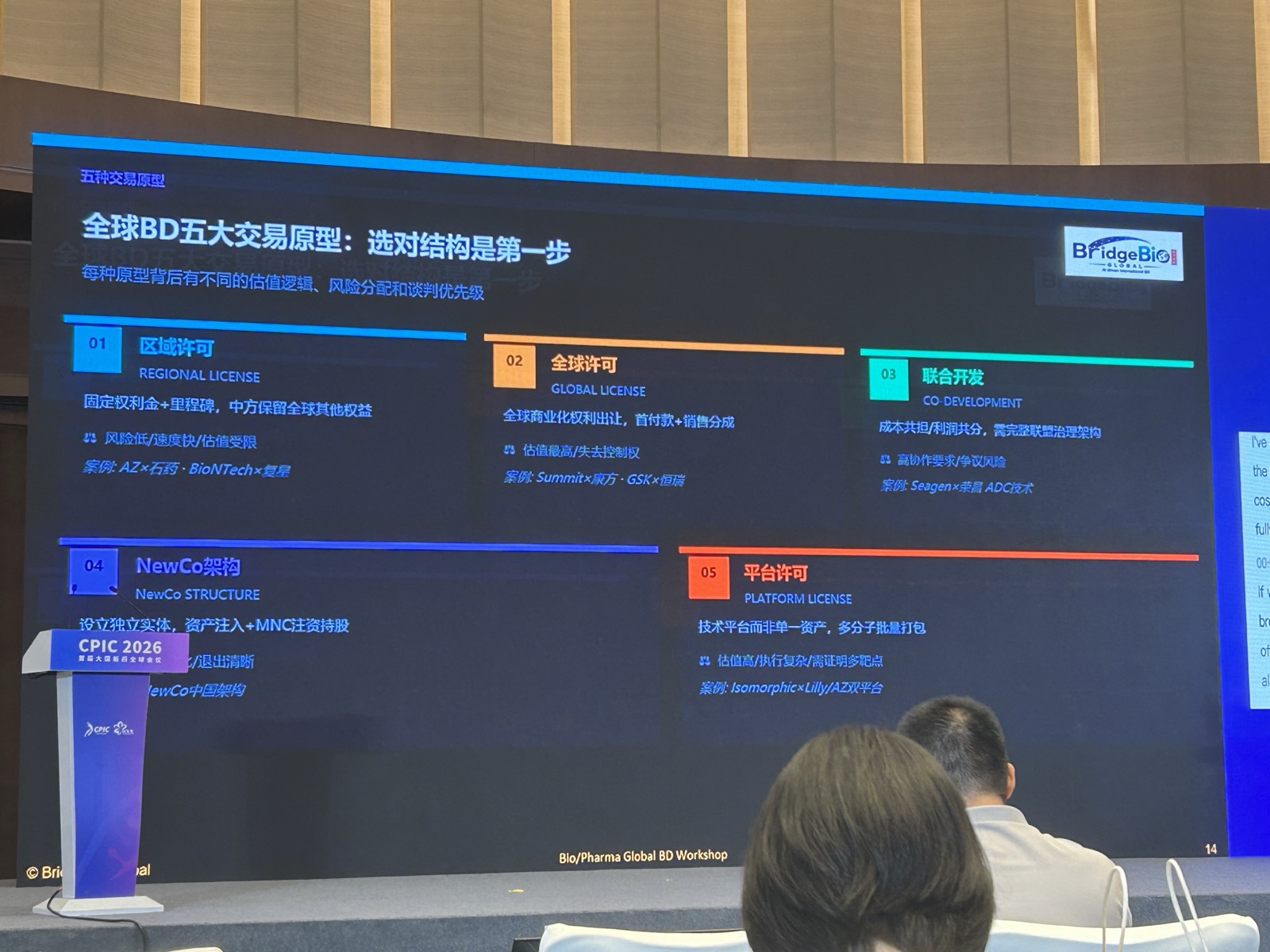
Zhang's workshop organized current BD activity into five deal archetypes, each with a different risk and valuation logic. We've kept his framework, corrected two of his examples, and added independently verified deal values where they were missing from the slide.
Regional license. A fixed royalty and milestone structure where the Chinese originator keeps rights outside the licensed territory. CSPC Pharmaceutical's January 2026 deal with AstraZeneca, worth up to $18.5 billion, is a current example. BioNTech's 2020 agreement with Fosun Pharma for exclusive China, Hong Kong, and Macau rights to its COVID-19 vaccine was an earlier one.
Global license. The originator transfers full global commercial rights in exchange for an upfront payment and royalty stream. Summit Therapeutics' 2022 deal with Akeso for ivonescimab, worth more than $5 billion, and Hengrui Pharma's strategic partnership with GSK, worth up to $12 billion, both fit this pattern.
Co-development. Both parties share cost and profit, which requires a fuller alliance governance structure than a simple license. The 2021 deal between Seagen and RemeGen for the ADC asset disitamab vedotin, worth up to $2.6 billion, is the standard example, with one correction worth making: Pfizer acquired Seagen in 2023, so the counterparty today is Pfizer, not Seagen. Pfizer took a $200 million impairment on the asset in its FY2024 results, a useful reminder that co-development structures carry real execution risk after signing, not just before it.
NewCo structure. A new, independent entity is formed around the asset, funded by a mix of the originating company and the MNC partner's equity stake, generally with a cleaner exit path than a straight license. OuroMedicines, built around an asset originated by Chinese biotech Keymed Biosciences, illustrates the model: its deal with Gilead is worth up to $2.175 billion, structured through the NewCo rather than as a direct China-to-US license.
Platform license. The deal covers a technology platform rather than a single molecule, often bundling multiple assets. Zhang's slide cited "Isomorphic × Lilly/AZ" as the example; that's not accurate. Isomorphic Labs' confirmed pharma partners are Eli Lilly and Novartis, both announced in January 2024 ($45 million upfront and up to $1.7 billion with Lilly; $37.5 million upfront and up to $1.2 billion with Novartis, later expanded). AstraZeneca isn't one of them.
Where the Deal Friction Actually Comes From
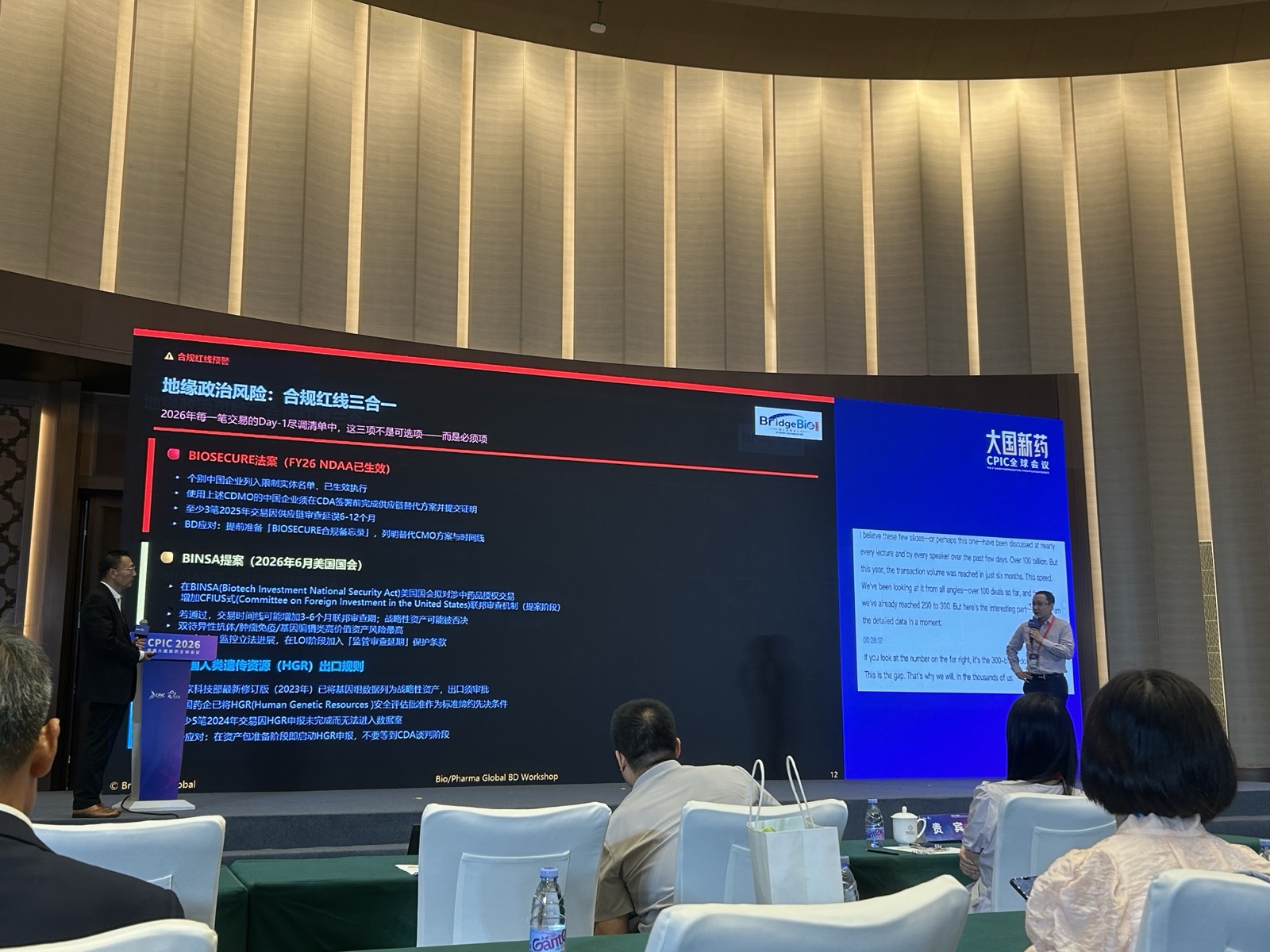
The workshop's regulatory section covered three compliance issues that now sit on the checklist for any China-US pharma deal.
The BIOSECURE Act is real and signed into law, part of the FY2026 NDAA passed in December 2025, though its practical bite is more gradual than the slide's "already in effect" framing suggested. Enforcement isn't expected before 2028, and the law includes a five-year wind-down safe harbor for existing contracts. That said, individual Chinese CDMOs already named on restricted entity lists face immediate effects today, and any Chinese company using a flagged CDMO needs a supply-chain alternative in place before signing.
BINSA, the proposed Biotech Investment National Security Act, is still just that: a proposal introduced in Congress in June 2026, not law. If it passes, it would add a CFIUS-style federal review that could extend deal timelines by three to six months, with bispecific antibodies, oncology immunotherapies, and gene-editing assets flagged as the highest-risk categories.
China's own friction point runs the other direction: the 2023 revision to its Human Genetic Resources export rules classifies genomic data as a strategic asset requiring export approval before it can leave the country. Zhang cited specific counts of deals delayed by BIOSECURE review and stalled by incomplete HGR filings. We couldn't independently confirm those exact figures, so we're not repeating them here. What multiple law firms and industry advisors do confirm, in general terms, is that both issues are now standard items on Day-1 diligence checklists for cross-border deals, not edge cases.
How the Money Says Yes
Zhang also walked through how a licensing decision typically moves inside a large pharma company's BD organization, useful context for anyone on the receiving end of it for the first time. Screening passes roughly 20-30% of opportunities through to a project review stage, where the first-payment range and milestone structure get an early shape. Due diligence follows: science, commercial, legal, and CMC workstreams running in parallel over four to eight weeks, including the IP, GCP, and HGR checks that can stall a deal at the data-room stage. The final stage requires sign-off from both the CEO and CFO, and by Zhang's account, roughly 30% of deals still have their structure modified at this last gate.
His broader point was a relational one: he estimated that more than half of successful BD deals originate outside formal settings like scheduled meetings, BIO, or ASCO. Screening happens on paper. Deals get made in the room next to it.
What's Moving Right Now
Zhang closed with a snapshot of recent deal activity to show the pace hasn't slowed. Checked against independent reporting, most of it holds up, with corrections on value and structure in two cases.
Ipsen agreed to acquire Kartos Therapeutics for up to $1.75 billion, for navtemadlin, an MDM2 inhibitor. That's a larger deal value and a different mechanism than the workshop slide stated. Novartis agreed to acquire Myricx Bio for up to $1.5 billion, split between a $1.1 billion upfront payment and $400 million in milestones, for its NMTi-ADC payload platform: a full acquisition, not the minority strategic stake the slide implied. Novo Nordisk struck a collaboration with Vivtex on oral biologics delivery worth up to $2.1 billion. That's real, but it's a bilateral deal rather than the dedicated fund the workshop described.
On the AI-drug-discovery side, the workshop's specific case study didn't hold up under verification and we're dropping it rather than repeat a number we couldn't source. The real benchmark deal worth citing instead is Insilico Medicine's agreement with Eli Lilly, $115 million upfront and up to $2.75 billion in total value, announced in early 2026. It's a legitimate marker of how seriously large pharma is now pricing AI-originated preclinical assets, and one we could confirm through primary sources rather than a single slide.
For biotech partnering or asset strategy discussions, contact Kerlann Advisory.